
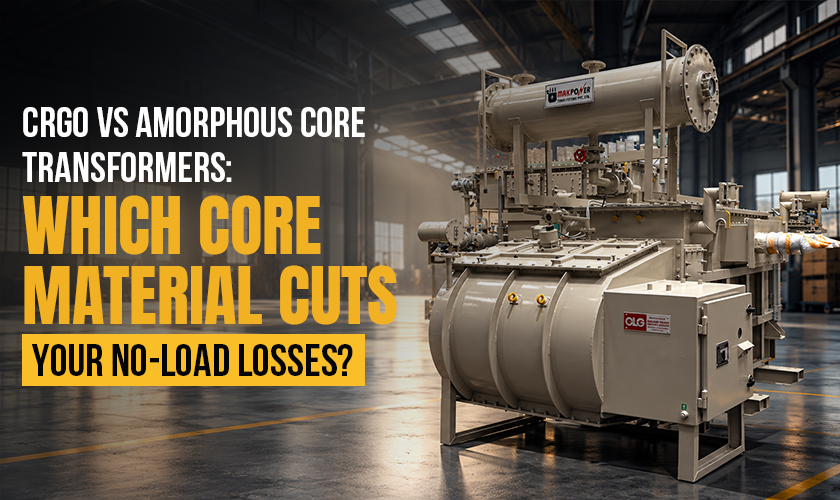
Efficiency in transformers is not just about the power delivered under load conditions. Transformers also use energy when they are energized but have no load. This energy loss occurs mainly due to the magnetic core and is called no load loss in transformer operations.
In cases where transformers are energized for extended periods of time, minimizing such losses would result in a reduction in total energy consumption. Such a comparison is especially important for choosing a type of transformer core material. Hence, in the amorphous core transformer vs CRGO discussion, which core loses less energy while operating with no load? In this blog, you will be aware of this fact.
What is the Transformer Core Loss?
A transformer core provides the necessary magnetic path needed to transfer energy from one winding to another. Whenever the transformer is energized, the magnetic field magnetizes and demagnetizes the core.
Core losses include two main types of loss:
- The hysteresis loss, which occurs due to the repeated magnetization and demagnetization of the core.
- The eddy current loss, which occurs due to the circulation of currents in the core.
While the copper losses occur due to loads applied to the transformer, these losses are experienced even if there is minimum or no secondary load on the transformer.
For this reason, proper selection of core material becomes very important while designing an energy efficient distribution transformer.
CRGO Transformer Core: The Proven Material Choice
CRGO represents the abbreviation for Cold Rolled Grain-Oriented electrical steel, which is one of the most common materials among transformer cores.
The oriented grain structure allows for good magnetic properties along the flux direction. This material is produced in thin insulated laminations that are intended to limit eddy currents and minimize core losses.
The properly designed CRGO transformer core provides the following benefits:
- Proven and widely utilized technology
- Good magnetic permeability
- Moderate core losses
- Good mechanical properties
- Wide availability for various transformers
Nevertheless, CRGO material has more features than just its designation. Core geometry, flux density, lamination characteristics, joint construction, and manufacturing process may also affect core loss.
The thin laminations and proper core design are especially critical since they minimize undesired currents and preserve the magnetic properties of steel.
Amorphous Core Transformers: Possibility for Reduced Core Loss
The atoms in an amorphous metal or metallic glass do not form any crystalline structure. As a result, amorphous metal has a magnetic property that differs from that of grain-oriented electrical steel.
Among the main benefits is the possibility of having reduced core losses in comparison with other materials.
In those cases when transformers work continuously, this feature may mean reduced energy consumption during the lifespan of the equipment.
This is why amorphous technology becomes especially attractive in distribution systems when the transformers operate for long periods under light loads.
But even reduced core losses cannot serve as the only reason to use amorphous technology in any case.
It is necessary to take into account core design, mechanical demands, physical parameters of the transformer, operational parameters, cost of procurement, and the purpose of the transformer.
Amorphous Core Transformer vs CRGO: Direct Comparison
The major difference between an amorphous core transformer vs CRGO is the magnetic loss behavior.
| Based on | CRGO Core | Amorphous Core |
|---|---|---|
| Material structure | Grain-oriented electrical steel | Non-crystalline metallic glass |
| No-load losses | Low | Generally lower |
| Eddy-current losses | Reduced through thin laminations | Very low due to thin ribbon construction |
| Manufacturing maturity | Highly established | More specialized |
| Application | Power, distribution and industrial transformers | Primarily efficiency-focused applications |
| Main advantage | Proven performance and broad applicability | Lower core/no-load losses |
In cases where the transformer stays active for several hours, its ability to sustain low core loss becomes useful.
Where proven construction methods and design versatility are required, CRGO continues to be widely employed.
Final Thoughts
The conclusion between the amorphous core transformer and the CRGO will depend on the application's priorities. Amorphous core transformers can be the best choice where minimizing no-load losses and core losses is the primary concern. On the other hand, CRGO is a well-proven technology and widely used in industries.
Transformer design should take into account proper use of transformer core materials and proper flux density, core design, winding design, insulation, cooling, and testing. If you are interested in energy-saving distribution transformers, power transformers, furnace transformers, dry-type transformers, and industrial transformers, then Makpower Trans Systems produces various transformer products. It specializes in energy-saving transformers with particular attention to their testing and design.
Related Posts

Dry Type vs. Oil Type Transformers:What You Need to Know
Transformers are getting more popular for modifying the supply.....
What is Transformer Oil & Its Importance
Transformer oil, also known as insulating oil, has a crucial.....

What are The Main Functions of a Transformer?
Transformers play a significant role in efficient electrical energy.....

Why Transformers Are Essential to the Industrial Sector?
Sufficient power supply is the backbone of any industrial operations.....