

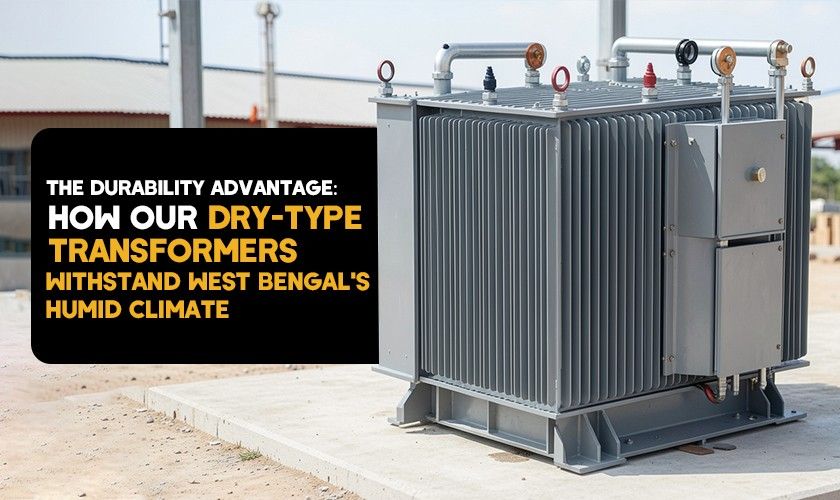
The Kolkata Salt Lake sector transformer substation has operated its cast-resin dry-type transformer since 2017. The facility has maintained perfect operational conditions through eight monsoon seasons because it experienced no oil leaks and no need for breather replacements. The maintenance log contains only a few entries, which makes it difficult to read.
India's dry-type transformer market reached a value of USD 230.48 million in 2024. The market will increase to USD 408.53 million by 2033 while experiencing a growth rate of 6.57%.
Oil-filled systems create more challenges than they resolve, which leads to that particular growth pattern.
The term durability lacks a clear definition. We will examine the effects of epoxy resin exposure to 90% relative humidity for six months.
Why Humidity Destroys Oil-Filled Units Faster Than You’d Think
The design of oil-immersed transformers depends on three components, which include a sealed tank, a conservator system and a silica gel breather system. The system functions as a closed system according to theoretical standards. The system becomes vulnerable to moisture infiltration through its gaskets and welded seams because every component acts as a moisture entry point.
The climate conditions of West Bengal turn every potential risk into an actual threat, which becomes certain after an extensive duration of time.
The CEA 2025 database, which tracks India's 1.3 million annual transformer failures, shows that moisture ingress, together with inadequate sealing methods, serves as the main reason for transformer failures.
The private utilities in Kolkata maintain their operations with failure rates that stay below 0.5% because they choose to spend substantial amounts on their predictive maintenance program and their quarterly oil testing procedures. Most industrial operators don’t have that infrastructure.
The dry-type transformer provides them with a solution which eliminates the complete issue.
The Epoxy Resin Advantage in Tropical Conditions
The dry type transformer uses a cast-resin system which creates a vacuum-cast epoxy shell to encase its windings. The system uses no oil, no paper insulation, no conservator and no breather system. The moisture protection system keeps moisture from entering because it prevents moisture from reaching its target.
The epoxy functions as an insulation material which belongs to Class F or Class H, with a thermal cutoff at 155°C and 180°C, respectively. The substance shows complete resistance to water absorption.
Procurement teams express their concerns regarding the maximum operating temperatures which dry-type units can maintain. The concern becomes valid when the power capacity exceeds 5 to 10 MVA because oil cooling systems provide better cooling performance for each volume unit.
The thermal performance of equipment between 25 kVA and 3,150 kVA exceeds all required standards. The windings can withstand 150 per cent of their normal capacity for 30 minutes because they maintain safe temperature levels.
The coastal location of West Bengal exposes oil-filled units to salt-laden air, which speeds up tank corrosion. The IP 23 and IP 44 enclosure systems protect dry-type transformers by decreasing their exposed metal surface area.
Maintenance Costs: Where the Real Savings Show Up
The upfront cost of a dry-type transformer exceeds its equivalent oil-filled unit by 20 to 35 per cent. The number causes procurement departments to feel fear. The total-cost-of-ownership calculation requires a 15-year evaluation. The process requires no oil testing, no oil filtration, no breather maintenance, no conservator inspection and no fire suppression system.
The company incurs no expenses to meet environmental regulations for oil spill containment. The 20 to 35 per cent premium seems like a reasonable cost after 15 years.
Conclusion
Not all applications require a dry-type transformer as their equipment solution. The remote outdoor substations and extreme overload applications still use oil-filled transformers as their preferred equipment.
The situation here requires more than one choice between two options. West Bengal hospitals, data centres, and industrial facilities in humid areas now prefer dry-type transformers as their standard equipment.
The concept of durability extends beyond constructing indestructible products. A product achieves durability when its design enables operation without experiencing environmental resistance. Customers can discover humid condition dry-type transformer solutions at Makpowerts.
Stats Used:
1. India dry-type transformer market: USD 230.48M (2024), projected USD 408.53M by 2033, CAGR 6.57% | IMARC Group
2. 1.3 million annual distribution transformer failures, moisture ingress as primary root cause | Business Standard / CEA
Related Posts

Dry Type vs. Oil Type Transformers:What You Need to Know
Transformers are getting more popular for modifying the supply.....
What is Transformer Oil & Its Importance
Transformer oil, also known as insulating oil, has a crucial.....

What are The Main Functions of a Transformer?
Transformers play a significant role in efficient electrical energy.....

Why Transformers Are Essential to the Industrial Sector?
Sufficient power supply is the backbone of any industrial operations.....