

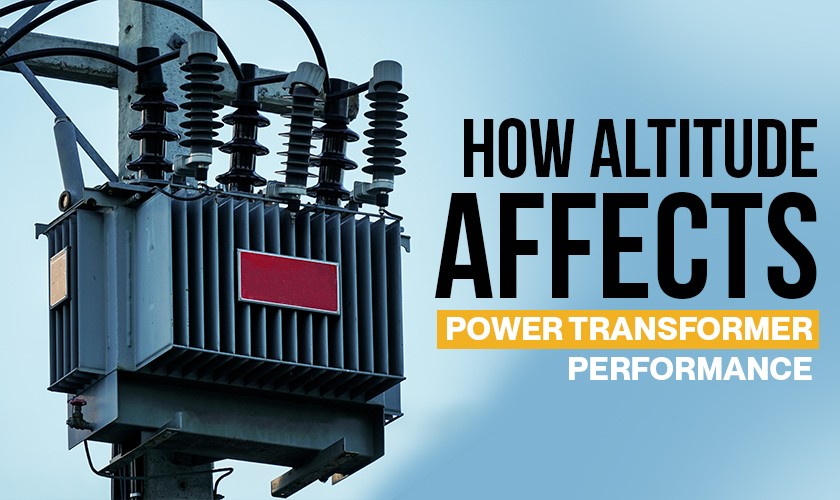
A site engineer once called our team convinced his brand-new transformer was defective. It kept running hotter than the datasheet promised, despite the load staying well within the nameplate rating. The transformer wasn't broken. It was installed at 2,400 meters, and nobody had accounted for altitude in the original spec.
That mistake is more common than it should be. Transformer installation at high altitude changes the physics of how a transformer cools itself, and if that isn't built into your planning, you end up with a unit that looks underperforming when it's actually just overheating quietly.
This piece explains why altitude matters, what the standards actually require, and how to calculate transformer derating for your specific site elevation.
Why Thinner Air Means Less Cooling
Transformers shed heat into the surrounding air. That's the whole basis of air-cooled and even some oil-cooled designs. The problem at elevation is straightforward physics: reduced atmospheric pressure at higher elevations lowers air density, and thinner air is measurably less effective at carrying heat away from the transformer.
Below a certain altitude, this effect is negligible and doesn't require any adjustment. But once you cross that threshold, the transformer's rated capacity starts to overstate what it can actually deliver safely.
Where the Threshold Actually Sits
Both major standards agree on where derating conversations need to start. IEEE C57.12.00 and IEC 60076 call for derating evaluation at elevations above 1,000 meters, or roughly 3,280 feet, and installations below that mark can generally use standard ratings without adjustment.
If your site sits below 1,000 meters, you likely don't need to think about this at all. Above it, the conversation changes fast, and the numbers add up quicker than most people expect.
- Below 1,000m: standard nameplate rating applies without adjustment.
- Above 1,000m: derating evaluation becomes necessary per IEC 60076 and IEEE C57.12.00.
- Manufacturer-specific derating curves should always override generic rules of thumb.
Calculating the Actual Derating Number
The commonly cited rule of thumb is a 1% capacity reduction for every 100 meters above the 1,000-meter threshold. To derate a 1000 kVA transformer installed at 2,000 meters, you'd calculate the 1,000-meter excess divided by 100, giving a 10% derating, which brings the usable capacity down to 900 kVA.
That's not a trivial haircut. On a large installation, a 10% capacity loss can mean the difference between comfortably running your load and quietly overloading the unit every single day. Some standards are more conservative still.
IEC 60076-2 specifies 0.3% derating per 100 meters above 1,000 meters for dry-type transformers specifically, so the exact factor depends on your transformer's cooling design and construction.
Oil-Filled vs Dry-Type: The Distinction Matters
Not every transformer type responds to altitude the same way, and this is where a lot of specification sheets get it wrong by applying one blanket rule. Liquid-filled transformers are generally less sensitive to altitude because oil cooling isn't affected by air density the same way, though they may still need dielectric insulation adjustments above 2,000 meters.
Dry-type units rely more heavily on ambient air for cooling, which makes them more exposed to the thinning-air effect. If your installation is genuinely high elevation, this distinction should shape which transformer type you spec from the start, not something you patch in after ordering.
Plan for Transformer Installation at High Altitude from the Start
When planning a transformer installation at high altitude, altitude should be treated as a core design parameter rather than a site condition to review after procurement. Beyond reducing cooling efficiency, higher elevations also reduce the dielectric strength of air, affecting insulation clearances and electrical withstand capability.
IEC and IEEE standards guide these adjustments, but the exact requirements depend on the transformer's design, cooling method, and installation elevation.
Likewise, transformer derating is not simply a matter of applying a generic percentage reduction. Oil-filled and dry-type transformers respond differently to altitude, and manufacturers often publish their own derating curves that should take precedence over general rules of thumb.
Reviewing these factors during specification helps ensure the transformer can safely deliver its intended capacity throughout its service life without excessive thermal stress or premature aging.
Wrapping Up
Altitude is not a minor specification detail. It directly influences both transformer cooling and insulation performance once an installation exceeds 1,000 metres. Ignoring these effects can result in higher operating temperatures, reduced efficiency, accelerated insulation ageing, and an increased risk of premature failure.
Whether you're planning a new transformer installation at high altitude or evaluating an existing system, factoring in transformer derating during the design stage helps avoid costly performance issues later.
At Makpower Trans-Systems, we work with customers to assess site elevation, cooling requirements, and applicable standards before manufacturing begins, ensuring every transformer is designed for the conditions in which it will actually operate.
Related Posts

Dry Type vs. Oil Type Transformers:What You Need to Know
Transformers are getting more popular for modifying the supply.....
What is Transformer Oil & Its Importance
Transformer oil, also known as insulating oil, has a crucial.....

What are The Main Functions of a Transformer?
Transformers play a significant role in efficient electrical energy.....

Why Transformers Are Essential to the Industrial Sector?
Sufficient power supply is the backbone of any industrial operations.....