
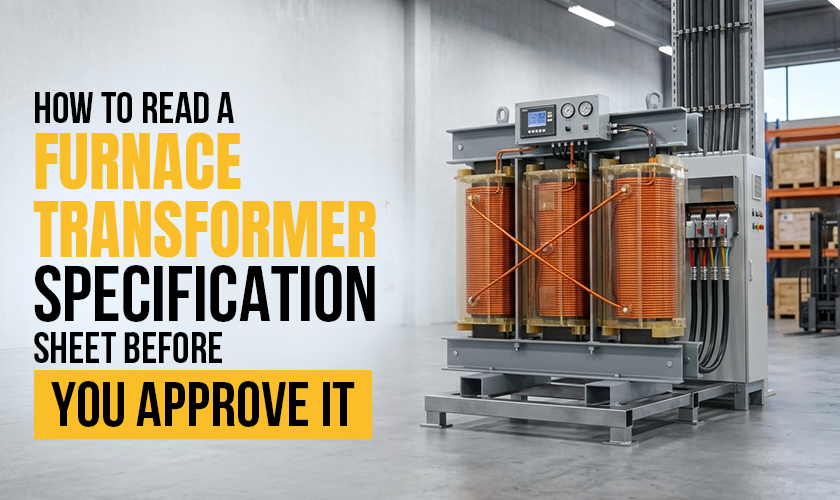
Giving the green signal to a furnace transformer is a crucial decision for any industrial plant. Whether it will be installed in a steel plant, foundry, or ferroalloy facility, the transformer needs to have the right electrical characteristics for that application. Any discrepancy between the capacity, voltages, currents, and cooling arrangement will influence the furnace efficiency, power consumption, and performance of the equipment.
This is why a furnace transformer specification sheet includes much more than just checking its MVA and voltage ratings. All technical parameters give valuable information about the performance of the transformer in operation. Prior to approving a furnace transformer for procurement or installation, buyers need to know the following technical parameters.
Evaluate the Rated Capacity and Voltage
In the furnace transformer specification sheet, the most important details mentioned are rated capacity and voltage. These are the most important criteria for examining a furnace transformer. Capacity signifies the required power the transformer is capable of handling. It is indicated by kVA or MVA. The necessary capacity is dependent upon the operating cycle, furnace type, and connected load.
These are the voltage specifications:
- Primary voltage: The voltage supplied to the transformer.
- Secondary voltage: The voltage reaching the furnace circuit.
- Voltage range: The operating range supported by the transformer.
An electric arc furnace transformer needs specifications aligned with the varied loads associated with steel melting. On the other hand, submerged arc furnace transformers should accommodate the electrical needs of ongoing smelting operations. Never approve a transformer only because of the capacity matching with the estimated load. See whether the voltage ratings are applicable for the available electrical supply and furnace.
Become Familiar With the Furnace Transformer Type
Different furnace applications are available, and for them there is no need for the same transformer designs. There is a requirement for different transformer designs. The specification sheet needs to clearly indicate the intended application. Some common furnace transformer types include:
- Electric Arc Furnace Transformers: These transformers deliver the high levels of electrical energy needed for scrap melting and steel manufacturing. The design of these transformers takes into consideration the changing load and operating conditions.
- Submerged Arc Furnace Transformers: This transformer type is used in ferroalloy manufacture, mineral processing, and other smelting processes. The design of these transformers caters to high-current operations and the particular electrical needs of the submerged arc furnaces.
- Ladle Refining Furnace Transformers: These transformers deliver controlled levels of electrical energy in secondary steelmaking processes.
- Induction Melting Furnace Transformers: These transformers are made for induction melting processes, where electrical energy is used to produce heat using electromagnetic induction.
Verify that the recommended transformer type suits your furnace process. An industrial transformer that is generally meant for power distribution does not necessarily fit furnace operations.
Look for Current Rating and Impedance
Current rating is another crucial parameter, as furnace transformers hardly operate under the required electrical loads. The rated current on the primary and the secondary side needs to be stated in the specification sheets. In particular, the secondary current is crucial since furnace designs require high current capabilities. The impedance, measured in percentage terms, denotes the resistance presented by the transformer against the alternating current in specific conditions.
-
It affects:
- Magnitude of short circuit currents.
- Voltage regulation.
- System stability.
- Transformer operation at different load levels.
It is imperative for buyers to select the right impedance depending on the furnace design and power system specifications. It is important to verify whether the recommended impedance is compatible with the existing system.
Identify the Tap Changer Arrangement
Furnace operations might need adjustments to the secondary voltage during separate production stages. The tap changer regulates the transformer voltage to align with these requirements. Anyhow, the specification sheet needs to examine the tap changer type and the operating range. There are two common arrangements:
- On-Load Tap Changer: Voltage adjustment is easier and while the transformer is energised and provides the load.
- Off-Circuit Tap Changer: Allows the transformer to get disconnected from the supply prior to changing the tap position.
Where there is frequent adjustment in voltage, the tap-changing system becomes essential. Verify the number of tap positions, range, and means of adjustment of the tap changing system prior to its approval. This system should be compatible with the operation cycle of the furnace.
Evaluate the Cooling System and Insulation
There are high levels of electrical and thermal stresses in furnace transformers. Hence, the cooling system and the insulation system affect the equipment reliability. The specification sheets must have a clear description of the cooling system, insulating materials used, and operating temperatures. The cooling system could be:
- Oil Natural Air Natural (ONAN)
- Oil Natural Air Forced (ONAF)
- Others, based on forced cooling systems.
Insulation materials include Kraft paper and others that are electrical grade. This transformer might include insulated aluminum or copper conductors. Find out if the cooling system is suitable for the operating conditions. Temperature rise limits must also be taken into consideration.
Confirm Core and Winding Information
Core and winding form an integral part of the furnace transformer. They play an important role in determining the performance, efficiency, and mechanical strength. It is expected that a specification sheet or another technical document will contain information regarding:
- Type of core material: Typically, cold-rolled grain-oriented steel is used for transformers' cores to reduce magnetic losses.
- Core assembly: Depending on the particular type of transformer, construction may be based on either butt-lap, mitre, or step-lap-mitre technique.
- Winding material: Conductors made of copper or aluminum might be used, depending on the required electrical rating of the transformer.
- Insulation: The insulation system must suit the particular electrical rating and conditions of operation.
Additionally, buyers should look into the winding configuration and mechanical support, especially when the transformer is intended for furnace applications with variable loading.
Learn about Transformer Losses and Efficiency Characteristics
Losses in transformers influence the operating costs over the course of their operating period. They need to be appropriately considered during the technical approval process. There are two major kinds of transformer losses:
- No-load losses: They appear as soon as the transformer is powered on, regardless of whether there is an actual load connected or not. Such losses are usually related to the magnetic core.
- Load losses They increase along with the growing current and are mostly caused by the winding resistance.
Such data needs to be presented in the specification sheet for guaranteed values of losses under specific conditions. Comparison of such data among manufacturers may help buyers assess the economic feasibility of using industrial transformers.
Conclusion
By carefully reading the furnace transformer specification sheets, the buyer can recognize possible inconsistencies even before purchasing the equipment. The capacity, voltage, impedance, tap changer arrangement, cooling system, insulation, and tests should be considered together rather than considered independently. The technical assistance of an experienced manufacturer could also come in handy while evaluating the requirements for such a transformer.
Being experts in designing transformers for electric arc furnace, submerged arc furnace, ladle refining and induction melting furnaces, the manufacturing facility of Makpower Transformers provides industrial transformer services. Collaborating with a technically sound manufacturer and considering all the specifications of the transformer could be useful to choose the right one for furnace installation.
Frequently Asked Questions
Why is impedance critical in a furnace transformer?
The impedance affects the short circuit current, voltage regulation, and the behavior of the transformer under different load conditions. The impedance should be compatible with the furnace and other electrical systems.
What are the tests done in a furnace transformer?
The usual tests include resistance of the windings, voltage ratio, insulation resistance, vector group, no-load losses, load losses, impedance test, and dielectric tests. Other tests can be done depending on the type of transformer and requirements.
Explain the difference between OLTC and OCTC.
The OLTC makes it possible to vary the voltage when the transformer is energized and supplying the load. However, the OCTC involves disconnecting the transformer first.
Which is the appropriate transformer for an electric arc furnace?
When it is about handling high-current requirements and varying electrical loads aligned with steel melting operations there is a need for electric arc furnace. The electric arc furnace is designed for such purpose.
What are the applicable standards for a furnace transformer?
Based on the transformer design and type the applicable standard is decided. Some relevant standards are IS 5553, IS 2026, and others.
Related Posts

Dry Type vs. Oil Type Transformers:What You Need to Know
Transformers are getting more popular for modifying the supply.....
What is Transformer Oil & Its Importance
Transformer oil, also known as insulating oil, has a crucial.....

What are The Main Functions of a Transformer?
Transformers play a significant role in efficient electrical energy.....

Why Transformers Are Essential to the Industrial Sector?
Sufficient power supply is the backbone of any industrial operations.....