

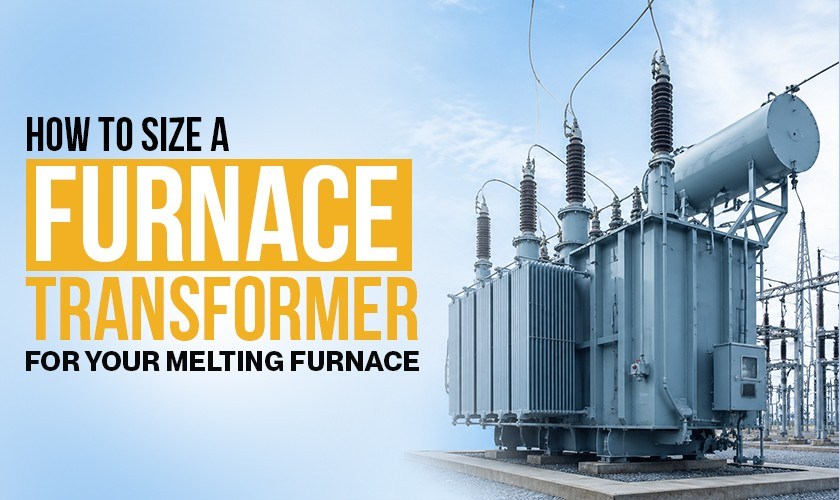
I once watched a foundry manager stare at an invoice for a transformer that had been running hot for eight months. The unit wasn't faulty. It was undersized from day one, and nobody caught it until the insulation started failing early. That's the kind of expensive lesson furnace transformer sizing is supposed to prevent.
Getting the furnace power requirement right isn't just an engineering formality. It decides whether your furnace melts at the rate your production line needs, whether your transformer survives its expected service life, and whether you're paying for capacity you'll never use. Get the number wrong in either direction, and you're looking at overheating on one side or wasted capital on the other.
This guide walks through the actual math behind transformer capacity calculation for melting furnaces, the factors that push your number higher than the textbook formula suggests, and a few mistakes we see repeated across foundries. You don't need an engineering degree to follow along. You need a calculator and about ten minutes.
Start With Your Furnace's Power Rating, Not a Guess
Every melting furnace, whether it's an induction unit or an arc furnace, has a power rating in kW. That's your starting point. But transformers aren't rated in kW. They're rated in kVA, which accounts for both the real power doing the melting and the reactive power the furnace's coils and magnetic fields demand.
The conversion is simple: kVA equals kW divided by power factor. If your furnace draws 400 kW at a power factor of 0.8, you need a transformer rated at 500 kVA to cover that same load. Skip this step, and you'll undersize the transformer without realizing it.
- Confirm your furnace's rated power from the nameplate.
- Check the power factor with your furnace supplier.
- Divide kW by power factor to get the true kVA demand.
Why Melting Rate Changes the Equation
Different metals need different amounts of energy to melt, and that changes how hard your transformer works over a shift. Cast iron typically needs 550-600 kWh per ton, while aluminium needs closer to 650-700 kWh per ton. A furnace melting aluminium all day draws differently than one cycling through cast iron batches.
This matters because your transformer isn't just handling instantaneous load; it's handling sustained draw across a shift. If you're melting a heavier-energy metal like steel, factor that into your capacity planning early, not after the transformer starts running warm.
Add a Safety Margin, Always
Nobody sizes a transformer to the bare minimum and calls it done. Industry practice adds headroom for exactly this reason. A common recommendation is to size the transformer at 120% of the calculated minimum kVA to prevent overload and protect the unit's working life.
That margin isn't padding for its own sake. Furnaces don't draw a flat, constant load. There are startup surges, cycling behavior, and future production increases to plan for. A transformer running comfortably below its ceiling ages more slowly and trips less often.
- Calculate your base kVA requirement from furnace power and power factor.
- Apply a safety factor of roughly 1.15 to 1.25 on top.
- Round up to the next standard manufactured size, never down.
Standard Sizes Exist for a Reason
Transformers aren't built in arbitrary increments. Manufacturers produce them in standard steps, and you always select the next standard size above your calculated requirement, never a size below it. If your math lands you at 62 kVA, you're going with 75 kVA, not rounding down to save a little on the purchase price.
This is where a lot of buyers get tempted to trim costs and pick the smaller unit. It's a false economy. The gap in upfront cost is nothing compared to replacing a transformer that failed early from sustained overload.
Final Checks Before Selecting Your Furnace Transformer
Accurate furnace transformer sizing goes beyond applying a single formula. While the initial transformer capacity calculation provides a solid starting point, the final specification should also consider real operating conditions such as harmonic distortion, ambient temperature, installation altitude, duty cycle, and expected production growth.
These factors can significantly influence the transformer's long-term performance and reliability.
It's equally important to validate the furnace power requirement using actual operating data rather than assumptions or nominal ratings alone. Reviewing the complete load profile before placing an order helps ensure the selected transformer can support continuous operation without unnecessary thermal stress or costly oversizing.
Wrapping Up
Successful furnace transformer sizing is built on a straightforward process: determine the actual furnace power requirement, perform an accurate transformer capacity calculation, add an appropriate safety margin, and select the next available standard transformer rating. Following these steps helps prevent overheating, improves equipment life, and avoids paying for capacity that your operation will never use.
A furnace transformer is a long-term investment, so it's worth verifying every design parameter before manufacturing begins.
At Makpower Trans-Systems, our engineering team works closely with foundries and industrial manufacturers to review load profiles, operating conditions, and future production plans, ensuring every transformer is correctly sized for reliable performance over its entire service life.
Related Posts

Dry Type vs. Oil Type Transformers:What You Need to Know
Transformers are getting more popular for modifying the supply.....
What is Transformer Oil & Its Importance
Transformer oil, also known as insulating oil, has a crucial.....

What are The Main Functions of a Transformer?
Transformers play a significant role in efficient electrical energy.....

Why Transformers Are Essential to the Industrial Sector?
Sufficient power supply is the backbone of any industrial operations.....