

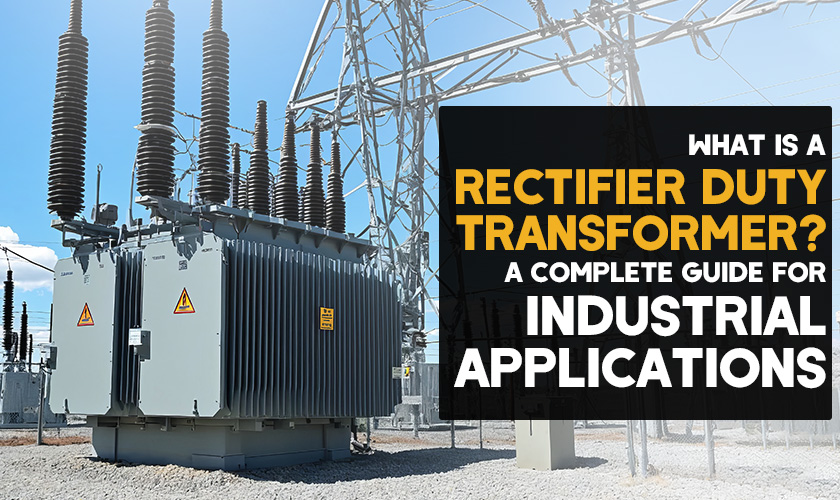
If you work in industries like electroplating, aluminum smelting, chemical processing, or DC motor drives, you’ve likely encountered rectifier systems. But many people wonder: what exactly is a rectifier duty transformer, and why can’t a regular transformer do the job?
That’s what we’ll cover today. By the end of this guide, you will have a clear understanding of what a rectifier duty transformer is, how it works, and why it is vital in industrial applications.
Let’s Start with the Basics
In many industrial processes, AC power isn’t sufficient. You need stable, controlled, and reliable DC power. This is where rectifiers come in. Rectifiers convert AC power to DC power, but this conversion creates a lot of electrical stress in the system.
This is where a rectifier duty transformer plays its role. Its job goes beyond simply adjusting voltage; it also prepares the AC supply so that rectifiers can convert it to DC efficiently and safely. A standard power transformer isn’t built to handle the harmonic currents, heat, and electrical distortions generated during rectification.
So, What Exactly Is a Rectifier Duty Transformer?
A rectifier duty transformer is a specially designed transformer for systems that convert AC power into DC power using rectifiers. Unlike regular transformers, these are made to handle non-linear loads, high harmonic currents, and continuous electrical stress.
Think of it this way: rectifier circuits do not draw smooth, sinusoidal current. Instead, they pull current in sharp pulses. These pulses create harmonics, raise heating in the windings, and can severely shorten the transformer's lifespan if the design isn’t strong enough.
A rectifier duty transformer is specifically built to endure—and perform well—under these conditions.
Why a Normal Transformer Won’t Work Here
This misconception is common. On paper, a regular transformer may seem suitable based on voltage and current ratings. However, in real-world situations, it’s a different story.
Rectifier loads cause harmonic distortion that leads to excessive heating, insulation stress, and higher losses. A standard transformer subjected to these conditions will deteriorate quickly, lose efficiency, and fail sooner than expected.
On the other hand, a rectifier duty transformer has reinforced insulation, lower flux density, and winding designs that can handle harmonic-rich currents. In short, it’s made for this task instead of being forced into it.
Key Design Features That Make the Difference
The design is what truly distinguishes a rectifier duty transformer. These transformers usually operate at lower flux density, minimizing core losses and overheating.
The windings are stronger to handle the electromagnetic forces from high current peaks.
Insulation systems are improved to manage increased thermal stress, ensuring a long service life even during continuous operation.
Often, phase shifting or multiple winding setups are included to reduce harmonics and enhance overall system performance. These design elements work together to ensure the transformer not only survives but thrives in tough rectifier environments.
Where Are Rectifier Duty Transformers Used?
You can find rectifier duty transformers in many industrial applications where DC power is necessary.
Electroplating plants use them for stable DC output during coating processes. Aluminum smelters depend on them to manage the large currents needed for electrolysis.
The chemical industry relies on them for electrolytic processes, while traction systems and DC motor drives count on them for consistent and reliable power conversion.
In each of these areas, power quality and reliability are essential. A transformer failure doesn't just cause downtime; it can disrupt entire production cycles.
That's why rectifier duty transformers are viewed as mission-critical equipment.
Heat, Harmonics, and Why They Matter
Let’s discuss two key factors in rectifier applications: heat and harmonics.
Harmonics are unavoidable in rectifier systems. They distort current waveforms and increase copper losses inside the transformer.
If extra heat isn’t managed well, it can speed up insulation aging and reduce transformer life.
A rectifier duty transformer comes with better cooling systems, often oil-cooled or water-cooled, to manage heat effectively.
By keeping operating temperatures in check, the transformer maintains efficiency and reliability even under constant load conditions.
Choosing the Right Rectifier Duty Transformer
Selecting the right transformer involves more than just looking at ratings—it requires understanding your process.
Load pattern, duty cycle, harmonic content, cooling needs, and operating environment all play a role.
That’s why customization is crucial. A transformer designed for one rectifier application may not perform well in another.
Consulting with an experienced manufacturer ensures that your rectifier duty transformer meets your specific operational needs instead of serving as a generic solution.
Final Thoughts
A rectifier duty transformer may not be the most visible component in your power system, but it is one of the most important.
It serves as the backbone of reliable AC-to-DC conversion, protecting your rectifiers, enhancing power quality, and ensuring smooth industrial operations.
Trying to save money by using a regular transformer in rectifier applications often results in inefficiency, frequent failures, and higher long-term costs.
Investing in the right transformer from the start pays off.
At Makpower Transformers, we focus on designing and manufacturing high-performance rectifier-duty transformers for harsh industrial environments.
Our solutions easily handle harmonics, thermal stress, and continuous operation, providing reliability you can trust.
Are you looking for a reliable rectifier duty transformer for your industrial application?
Contact Makpower Transformers today, and let our experts create the right solution for your power needs.
Related Posts

Dry Type vs. Oil Type Transformers:What You Need to Know
Transformers are getting more popular for modifying the supply.....
What is Transformer Oil & Its Importance
Transformer oil, also known as insulating oil, has a crucial.....

What are The Main Functions of a Transformer?
Transformers play a significant role in efficient electrical energy.....

Why Transformers Are Essential to the Industrial Sector?
Sufficient power supply is the backbone of any industrial operations.....