

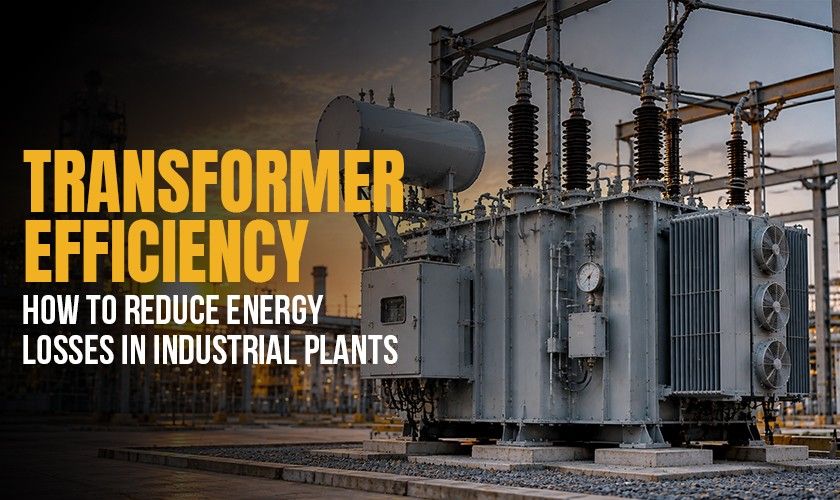
To ensure that the production process continues in an effective way, industrial plants require a reliable source of power. In applications involving steel, metal treatment, manufacturing, and heavy engineering processes, transformers are required to ensure the conversion and distribution of electrical energy.
All transformers use some amount of the energy that passes through them, and this leads to higher operational costs when the equipment is not used efficiently. There is no doubt that transformer energy efficiency has therefore become a very important aspect of operations.
Remember that it is vital for controlling electricity usage in industry and for improving the performance of equipment. This can also go a long way in reducing unnecessary operating costs in industry.
Overview of Transformer Energy Losses
Transformers’ power losses can be broadly categorized into two groups. The first one is core loss, and the other one is load loss.
Core loss occurs when there is a supply going to the transformer, irrespective of whether it is carrying any load or not. The losses due to hysteresis and the eddy current effect in the core material cause these losses. As these losses occur during the operation of the transformer, the core material used determines the efficiency of the transformer.
The load losses occur due to the effect of the current on the transformer windings. There will be losses due to the resistance offered by the winding material and the heat generated in it, which causes copper loss. The load loss occurs in proportion to the load on the transformer.
Industrial transformer efficiency improvement is important in such cases.
Select an Energy Efficient Transformer
The best way to enhance efficiency is by choosing an energy efficient transformer. It can align with the actual needs and requirements of the plants.
Exceeding the size of a transformer can lead to redundant investments and more no-load losses. On the other hand, decreasing the size can lead to heavy loading, more heat, lower efficiency, and accelerated insulation ageing. Before installing a transformer, you need to evaluate the capacity, voltage class, application requirements, and operating conditions.
In the case of industrial installations, the selection may also be based on the type of process involved. Electrical features of furnaces, power distribution systems, manufacturing plants, and other challenging installations can be very different from one another. It is better to use a transformer tailored for the particular application as opposed to a general-purpose transformer chosen based on its capacity alone.
Optimizing Core Design to Ensure Low No-Load Losses
Core design is directly responsible for determining energy efficiency. The choice of material, optimal flux density, and proper core design will help reduce the level of core loss.
The transformer cores are manufactured using optimum flux density with the goal of minimizing core loss. Undoubtedly, the thin laminations and high-resistance insulation help to lower the impact of eddy currents.
Several types of core construction techniques are used, such as butt-lap, miter, or step-lap-miter construction. It is important to pay special attention to core design for industrial applications since small decreases in continuous no-load losses can provide significant energy savings.
Decrease Winding and Load Losses
Winding design cannot be overlooked when it comes to the efficiency of a transformer’s energy. Electrical resistance in the windings can generate heat, and high current levels trigger these losses.
Proper selection of material for conductors, accurate sizing of windings, and ensuring good cooling passages can help in controlling temperature and improving operation. Various companies utilize either electrolytic copper or aluminium with high conductivity based on the specific needs of the application. The winding structure also features cooling passages to assist in managing hot spots.
Plants that use transformers should also ensure that they do not overload transformers by working outside the specified range of loads.
Cooling and Operating Temperature is a Priority
Heat is the most crucial factor responsible for affecting the transformer service life and performance. It often happens that a transformer operates at a high temperature, losses exceed limits, and insulation can deteriorate steadily.
A proper cooling arrangement allows the generated heat to disappear during operation. Based on the application and transformer, cooling systems can include fans, heat exchangers, and oil pumps.
Various manufacturing processes implement different cooling arrangements that are chosen according to the transformer's needs and operating conditions. If it is about keeping the efficiency intact, it is better to maintain cooling systems and ensure enough ventilation.
Transformer Energy Can Become a Part of Energy Strategy
TEnhancing the efficiency of transformers does not necessarily mean having to buy new transformers. Efficiency of transformers is achieved through proper selection, reducing core and winding losses, managing the loading, ensuring cooling, monitoring conditions of operation, and performing proper testing.
For companies that have transformers that run continually, this would be a better way to reduce energy consumption, increase reliability, and control costs of operation. A properly designed transformer with proper operation and maintenance can become an integral component of a company’s energy management system.
In selecting industrial transformers, it is also crucial to work with manufacturers that understand the needs of the application. Makpower Trans-Systems produces several types of transformers, including energy-efficient power and distribution transformers, furnace transformers, dry-type transformers, and customized transformers.
Related Posts

Dry Type vs. Oil Type Transformers:What You Need to Know
Transformers are getting more popular for modifying the supply.....
What is Transformer Oil & Its Importance
Transformer oil, also known as insulating oil, has a crucial.....

What are The Main Functions of a Transformer?
Transformers play a significant role in efficient electrical energy.....

Why Transformers Are Essential to the Industrial Sector?
Sufficient power supply is the backbone of any industrial operations.....