

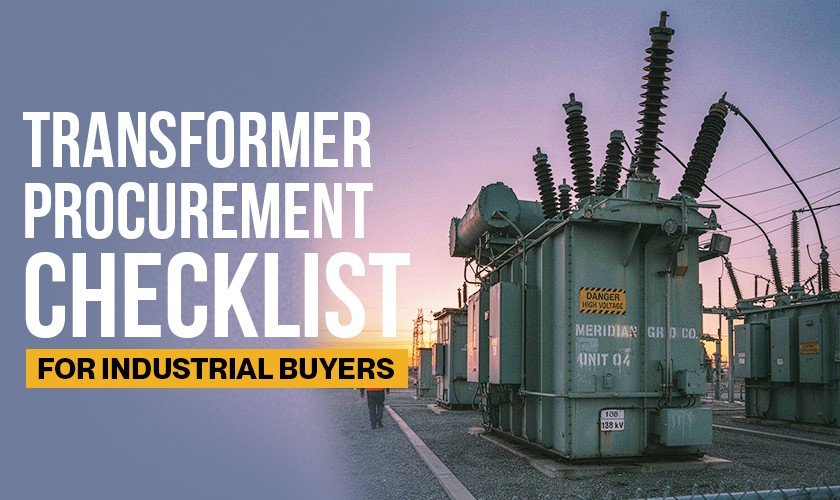
A transformer is one of the most critical assets in any industrial power distribution system. Whether it's feeding a manufacturing plant, a processing facility, or an infrastructure project, its performance shapes production reliability, equipment safety, and operating costs for decades to come. Selecting the right one isn't just a purchasing task. It's an engineering decision, and it deserves to be treated like one.
An incomplete specification, or a procurement process built around price alone, tends to show up later as extended lead times, compatibility problems, inefficient operation, or early equipment failure. The National Electrical Manufacturers Association (NEMA) points to unclear purchasing specifications as a leading cause of bidding delays and stretched delivery schedules.
This transformer procurement checklist walks through the technical points industrial buyers should nail down before placing an order.
Why Transformer Procurement Needs More Than a Price Comparison
Industrial transformers are built to stay in service for decades, running under shifting loads and environmental stress the whole time. Buy on price alone, and you often pay for it later, through higher losses, more maintenance, or a shorter working life.
A well-defined procurement process helps ensure the transformer:
- Matches present and future load requirements
- Meets applicable electrical standards
- Integrates with existing infrastructure
- Supports reliable long-term operation
- Simplifies installation and commissioning
The Central Electricity Authority (CEA), in its standard specifications for transformers and reactors, treats design review, manufacturing quality, and technical verification as central to getting the full expected service life out of a transformer.
Define Your Electrical Requirements Before Requesting Quotations
Before approaching manufacturers, put together a full technical specification. Requesting quotes on kVA rating alone leaves too much to guesswork.
Load Profile
Always work out:
- Connected load
- Maximum demand
- Average operating load
- Expected load growth over the next 10 to 20 years
Oversize the unit, and you're paying more upfront in capital cost and no-load losses. Undersize it and you shorten equipment life and box yourself into a corner on future expansion.
Voltage Requirements
Be sure to specify both primary voltage and secondary voltage. Also confirm:
- Frequency (typically 50 Hz in India)
- Phase configuration
- Vector group requirements
These parameters determine whether the transformer will actually play nice with your existing network.
Installation Environment
Where the transformer lives affects how it's built. Consider:
- Indoor or outdoor installation
- Ambient temperature
- Humidity
- Dust levels
- Chemical exposure
- Coastal or corrosive environments
- Altitude
These conditions drive decisions on insulation systems, cooling arrangements, enclosure ratings, and how often the unit will need maintenance.
Future Capacity Expansion
Industrial facilities rarely stay the same size for long. If you expect production to grow, specifying a transformer with some design margin now usually costs less than replacing an undersized one later.
Transformer Procurement Checklist
Before buying an industrial transformer, go through this transformer procurement checklist:
| Procurement Item | Why It Matters |
|---|---|
| Transformer rating (kVA/MVA) | Determines load-handling capability |
| Primary and secondary voltage | Confirms system compatibility |
| Cooling method (ONAN, ONAF, Dry Type, etc.) | Affects operating temperature and reliability |
| Percentage impedance | Affects fault current and voltage regulation |
| Efficiency and loss values | Drives lifetime operating cost |
| Insulation class | Matches expected operating conditions |
| Protection requirements | Improves operational safety |
| Tap changer configuration | Enables voltage regulation |
| Applicable standards | Confirms compliance with project specs |
| Accessories | Supports monitoring, protection, maintenance |
| Warranty terms | Defines manufacturer support |
| Spare parts availability | Reduces maintenance downtime |
Working through this list before you send out enquiries means manufacturers respond with real proposals, not assumptions dressed up as quotes.
Request Complete Technical Documentation
A transformer quotation should never be just a price and a delivery date. During technical evaluation, ask for:
- Guaranteed Technical Particulars (GTP)
- General Arrangement (GA) drawings
- Routine test reports
- Type test reports where applicable
- Loss calculations
- Quality assurance documentation
- Installation and operation manuals
- Foundation requirements
- Recommended maintenance schedule
The CEA's standard specifications treat design review and documentation verification as steps that happen before manufacturing starts, not after. Reviewing the paperwork early cuts down on engineering changes once production is already underway.
Verify Manufacturing and Testing Capabilities
Transformer quality isn't only a design question. It comes down to how the unit is built and tested. Check whether the manufacturer runs:
- Routine factory testing
- Insulation resistance testing
- Ratio testing
- Winding resistance measurement
- Applied voltage tests
- Induced voltage tests
- Functional testing of accessories
On larger projects, it's worth specifying a Factory Acceptance Test (FAT) before the unit ships. Testing is what proves the transformer you're getting matches the transformer you specified, before it ever reaches site.
Common Procurement Mistakes to Avoid
Even procurement teams with years of experience can miss details that come back to bite them later.
- Buying on price alone. Sizing only for today's load often creates a capacity bottleneck within a few years.
- Ignoring future expansion. Sizing only for today's load often creates a capacity bottleneck within a few years.
- Incomplete specifications. Missing details lead to quotation revisions, back-and-forth clarifications, and delays.
- Overlooking site conditions. Dust, moisture, and high ambient temperatures all shape what transformer design is appropriate.
- Skipping the documentation review. Missing drawings or test certificates can hold up installation, commissioning, and regulatory sign-off.
Choose a Manufacturer That Stays Involved Past the Sale
Procurement doesn't end at manufacturing. Look for suppliers who'll work through the specification with you, support you during installation, hand over full testing documentation, and stay reachable afterward if something needs attention. That kind of involvement is what actually reduces project risk.
A structured procurement process, covering electrical specification, documentation, testing, and future capacity, is what separates a transformer that performs for its full 30-plus-year life from one that becomes a maintenance problem within a few years of installation. Makpower Trans-Systems manufactures a range of industrial transformers to choose from.
Related Posts

Dry Type vs. Oil Type Transformers:What You Need to Know
Transformers are getting more popular for modifying the supply.....
What is Transformer Oil & Its Importance
Transformer oil, also known as insulating oil, has a crucial.....

What are The Main Functions of a Transformer?
Transformers play a significant role in efficient electrical energy.....

Why Transformers Are Essential to the Industrial Sector?
Sufficient power supply is the backbone of any industrial operations.....