

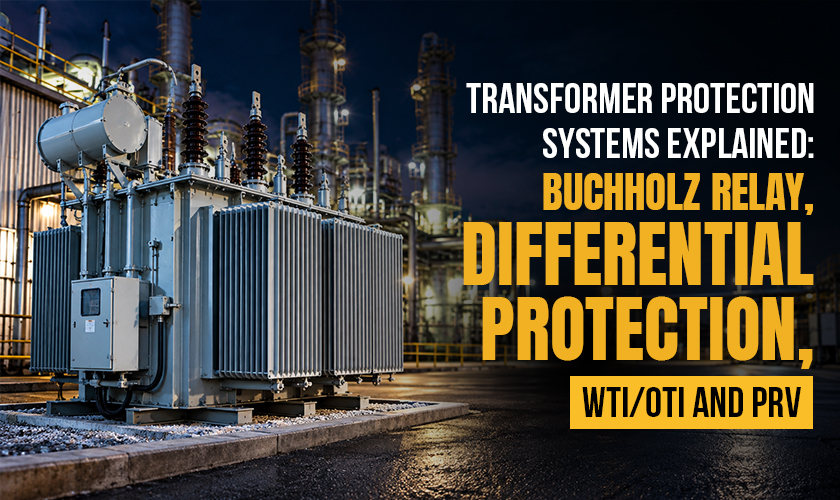
Transformers are important in industries and power systems. However, transformers may experience electrical faults, overheating, insulation failure, and excessive pressure. Hence, effective protection is necessary to enable quick detection of abnormal conditions to ensure that the small problem does not develop into a major failure.
A transformer protection relay functions together with mechanical and thermal protective devices to protect the transformer. Some of the devices that are commonly used include Buchholz relay, differential protection, WTI, OTI, and PRV. Each of these serves its own purpose in protecting the transformer.
Everything About the Transformer Protection System
Transformer protection system refers to a collection of relays, sensors, and mechanical devices that detect any problem within the transformer. According to the type and usage of the transformer, the following faults could necessitate protection from:
- Short circuit and earth fault within the transformer
- Overcurrent
- High winding or oil temperatures
- Formation of gas within the transformer
- Rapid oil movements
- High tank pressures
Multiple transformer fault protection devices should be used since none of them can detect all kinds of faults by itself.
Buchholz Relay
The Buchholz relay is a mechanical relay that is widely used for protection of oil-filled and conservator type transformers. It is mounted on the pipe connecting the transformer tank with the conservator.
Principle of Buchholz Relay
The principle of the Buchholz relay is based on gas production and the rapid oil flow due to internal transformer faults.
Internal fault development may cause heating or arcing in the transformer. This results in oil and insulation breakdown with the formation of gases inside the relay triggering the alarm.
In case of a serious internal transformer fault, the fast gas generation causes the rapid oil flow from the transformer to the conservator. This action is detected by the relay and causes a trip operation of the transformer.
Thus, the Buchholz relay can be used for an early indication of internal faults and for their protection in some cases.
Differential Protection of Transformer
The technique of differential protection of a transformer is an electrical protection scheme that detects faults occurring within the transformer's protection region.
This technique works by comparing the currents coming into the protected region of the transformer and those going out. In normal circumstances, these two are suitably balanced, taking into consideration the transformation ratio of the transformer.
In the event of an internal fault, the balance of these currents will be affected such that the difference could actuate the protection relay to trigger tripping.
Differential protection could detect the following types of faults:
- Phase to Phase
- Phase to Earth
- Winding Fault
WTI and OTI in Transformer
Temperature measurement also forms another crucial aspect of transformer protection. WTI and OTI in transformer offer details on various temperatures.
OTI - Oil Temperature Indicator
The Oil Temperature Indicator is used to measure the temperature of the insulating oil of the transformer, usually at the top level.
Increase in oil temperature occurs due to high loading, insufficient cooling, high ambient temperature, or any other abnormal condition. According to the protection scheme, OTI may offer indications and trip signals.
WTI - Winding Temperature Indicator
The Winding Temperature Indicator indicates the estimated temperature of the winding. It usually employs thermal simulation to offer an indication of the winding temperature.
Pressure Relief Valve
In the event of a serious internal transformer fault, there may be an increase in the pressure within the tank. The pressure relief valve transformer system helps in discharging any excess internal pressure that goes beyond the set threshold of operation of the device.
The pressure relief valve is normally closed in regular operation but opens in the presence of any excess pressure. It may also offer electrical tripping.
Therefore, the PRV becomes an important mechanical protective device.
Interrelatedness of Transformer Protection Schemes
Instead of superseding each other, the various protection schemes function alongside each other.
As an illustration, an internal electrical problem could lead to operation of differential protection. In case this results in gas accumulation or oil flow due to the fault, then Buchholz relay would be able to detect it. Any fault or abnormal loading leading to overheating is monitored by WTI or OTI schemes. An internal fault causing a quick rise in tank pressure leads to activation of the PRV.
Thus, different kinds of abnormal situations are monitored using the appropriate protection schemes.
Final Thoughts
A well-designed transformer protection scheme involves electrical, thermal, and mechanical protection to cater to various fault situations. The differential protection can detect any electrical fault inside the transformer, Buchholz relay is used for gas accumulation and oil flow in certain transformers.
WTI and OTI are used for thermal protection, and the PRV assists in controlling the high internal pressure. In industries and for power requirements, Makpower Transformers offers several transformers. They include power transformers, distribution transformers, dry-type transformers, furnace transformers, and special transformers.
Related Posts

Dry Type vs. Oil Type Transformers:What You Need to Know
Transformers are getting more popular for modifying the supply.....

What is Transformer Oil & Its Importance
Transformer oil, also known as insulating oil, has a crucial.....

What are The Main Functions of a Transformer?
Transformers play a significant role in efficient electrical energy.....

Why Transformers Are Essential to the Industrial Sector?
Sufficient power supply is the backbone of any industrial operations.....