

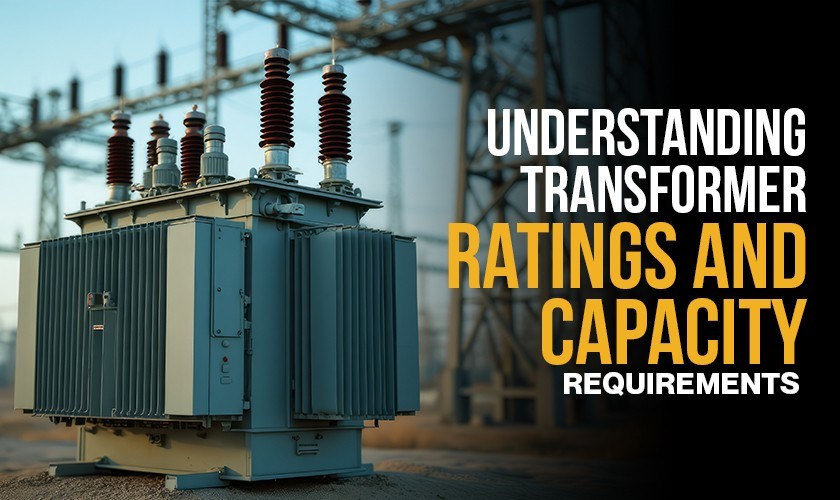
Every transformer has a rating stamped on its nameplate. It tells you the voltage, the frequency, and a number in kVA or MVA that represents capacity. Most people treat that number as a simple ceiling: don't exceed it, and you're fine. In practice, power transformer rating is considerably more nuanced than that, and understanding what the number actually means can save you from a costly selection mistake.
India's transformer market is expected to reach USD 3.25 billion in 2026 and grow at a CAGR of 8.22% through 2031, according to Mordor Intelligence. That's a lot of transformer purchases happening across utilities, industry, and infrastructure. A significant number of those purchases are sized incorrectly, either undersized and prone to failure or oversized and operating inefficiently at a fraction of the rated load.
Getting transformer capacity right starts with understanding what the rating is actually measuring.
Why kVA, not kW?
Here's something that trips up a lot of people. A transformer's capacity is rated in kVA, which measures apparent power, not kW, which measures real power. The distinction matters because a transformer has to carry current regardless of the load's power factor.
Think of it this way: a facility drawing 800 kW at a power factor of 0.8 actually demands 1,000 kVA from the transformer. The transformer doesn't see kilowatts. It sees current. And current generates heat in the windings, regardless of whether that current is doing useful work or just cycling reactive energy back and forth.
This is why facilities with variable frequency drives, large motor banks, or rectifier loads tend to consume transformer capacity faster than their kW figures suggest. The power transformer rating is set by thermal limits, and those limits respond to current, not just active power.
How Ratings Are Set
A transformer's kVA rating reflects the maximum apparent power it can deliver continuously without exceeding the temperature rise limits defined by its insulation class, under specified ambient conditions and cooling class.
Four things jointly determine what that number can be:
- Conductor size: Larger cross-sections carry more current before resistive heating becomes a problem
- Core material and geometry: Better steel grades allow higher flux density without excessive magnetising losses
- Insulation class: Higher temperature ratings allow the transformer to run hotter without degrading
- Cooling method: ONAN (natural oil/air) has lower continuous ratings than OFAF (forced oil/forced air) for the same physical size
When you see a transformer with multiple kVA ratings listed, such as 1000/1250/1600 kVA, those correspond to different cooling configurations. The base rating assumes natural cooling. The higher ratings assume fans and pumps are running.
Calculating What You Actually Need
Start with your maximum connected load in kW. Divide by the worst-case power factor of your installation to get your kVA demand. Then add a margin.
The standard engineering guidance recommends a 10-25% margin above calculated peak demand for two reasons. First, electrical loads grow over time, and replacing a transformer before it's worn out is expensive. Second, transformers run more efficiently at 70-80% of rated load than at 100%. Running a transformer continuously at full capacity reduces its service life and increases losses.
For industrial sites with large inductive loads, also account for motor starting currents. A motor drawing 5x its rated current during startup creates a short but significant demand spike that the transformer must handle without tripping protection.
Where Oversizing Becomes a Problem
It's tempting to buy a bigger transformer "just to be safe”. But oversizing has its own costs. A transformer operating at 20-30% of rated load runs at lower efficiency than one correctly sized for its load. No-load losses, which are fixed regardless of how much power you're drawing, become a larger proportion of total losses when actual throughput is low.
For commercial and light industrial applications where load growth is predictable and modest, oversizing by more than 25-30% above current demand usually isn't justified.
Ratings in Practice: Industrial vs. Utility Applications
For industrial applications, the power transformer rating selection also has to account for the specific load type. Furnace transformers, rectifier transformers, and welding transformers all have duty cycle characteristics that differ from a standard distribution transformer running a stable resistive load. A furnace transformer, for instance, might see full-load current for only 60% of a cycle but with significant harmonic content throughout.
Utility-grade transformer capacity decisions involve additional parameters: fault level contribution, impedance matching within the network, and protection coordination with upstream and downstream equipment.
A Final Word on Getting It Right
Selecting a transformer is not a back-of-the-envelope exercise for anything beyond the simplest application. Load profiling, power factor measurement, harmonic assessment, and growth projection all feed into a proper specification. Getting one of these wrong doesn't just affect efficiency; it affects how long the transformer lasts.
Makpower Trans-Systems has been working with industrial and infrastructure clients on exactly this kind of specification work, helping translate load requirements into transformer ratings that perform reliably across their intended service life.
Related Posts

Dry Type vs. Oil Type Transformers:What You Need to Know
Transformers are getting more popular for modifying the supply.....

What is Transformer Oil & Its Importance
Transformer oil, also known as insulating oil, has a crucial.....

What are The Main Functions of a Transformer?
Transformers play a significant role in efficient electrical energy.....

Why Transformers Are Essential to the Industrial Sector?
Sufficient power supply is the backbone of any industrial operations.....