

Voltage fluctuations are one of those industrial problems that stay invisible right until the moment they become catastrophic. A motor trips unexpectedly. A production line loses rhythm. Equipment that costs millions starts failing years before its time. The culprit, more often than not, isn't a dramatic power outage. It's the quiet, relentless variation in supply voltage that accumulates damage over time.
This is precisely the issue that the step voltage regulator is designed to address. The device not only protects but also regulates the level of voltage by ensuring that it stays within the acceptable range without the necessity for constant adjustments by the operator each time there is a drop or rise in the power grid. In cases where voltage stabilization affects product output, nothing else can come close.
This post will describe how the automatic voltage regulator transformer functions, why the stepping mechanism works well, and which applications use the devices regularly.
What Is an Automatic Step Voltage Regulator
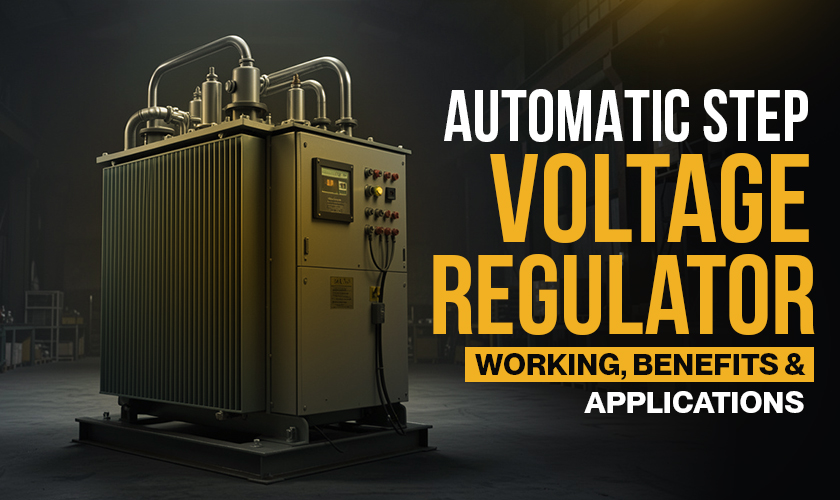
The Automatic Step Voltage Regulator (ASVR) is a special type of electrical equipment created specifically to maintain the output voltage at a specified level, despite any changes in the input voltage. As opposed to other systems of regulation working with stepless voltage regulation, which tends to be slower, the ASVR employs a tap-changing technique for adjusting the voltage in steps.
It relies on the theory of autotransformers. The operation is continuous; there are no interruptions in the process of correction caused by changing loads and power supplies. This is especially important in cases when high voltages are regulated, since even momentary power supply disruptions are expensive.
The Working Principle In Four Steps
The automatic step voltage regulator works in four phases as follows:
Voltage Detection: An always-on detection circuit detects the level of output voltage.
Comparison and Decision: The system will compare the detected voltage with the preset limit.
Tap Changer Action: If any difference is found, then an on-load tap changer is used to adjust the position of the winding at a fixed step interval, which may be up to 32 or 33 taps.
Correction through Feedback Loop: After that, the measurement of the output will again take place until the proper voltage limit is achieved.
A modern automatic step voltage regulator can go from one tap to another within 10 seconds. This means that in case of any sudden change in load, it can handle it without damaging any sensitive equipment.
Key Benefits of an Automatic Step Voltage Regulator
By installing an automatic step voltage regulator, you get the following benefits:
Continuous Voltage Stability
The most obvious benefit is what the name promises: stable voltage. Where other methods might react slowly or cause brief interruptions during correction, the ASVR adjusts on-load, meaning the connected equipment never experiences a supply break during regulation.
Equipment Protection
Voltage deviation doesn't just cause tripping; it causes gradual deterioration. Motors running at low voltage draw higher current and overheat. Equipment operating at elevated voltage stresses insulation systems. An automatic voltage regulator transformer eliminates both risks by keeping voltage within acceptable bands at all times.
Energy Efficiency
When voltage is consistently maintained at the optimal level, energy losses across the system drop. Over a full year of operations, that adds up. Industries with high-load environments see measurable reductions in energy waste simply by deploying proper voltage regulation.
Lower Maintenance Requirement
A device working within its voltage rating experiences less malfunctioning and requires less frequent emergency maintenance, spare replacement, and overhaul work. As a matter of fact, the ASVR compensates for its costs due to the higher life cycle of equipment.
Where ASVRs Are Most Commonly Used
The step voltage regulator is applied extensively in various industry sectors and power grid conditions:
Distribution networks: The utility installs ASVRs in substations and feeder lines where the terminal voltage drops below an acceptable level because of long distances in the distribution lines.
Industrial applications: The steel mills, foundries, and chemical industries have been using ASVRs to provide protection to sensitive industrial process equipment during heavy current surges or arc furnaces.
Electrification of rural areas: Long distribution lines that serve farmlands or semi-urban areas frequently suffer from a voltage drop. ASVR is the most common application for solving voltage drop issues.
Energy generated by renewables: Photovoltaic solar cells and wind farms present the issue of intermittent power supply, leading to voltage fluctuations. ASVR acts as the buffer for voltage control.
Commercial and real estate sector: Commercial complexes with fluctuating power loads may install ASVR to safeguard the electrical system, HVAC, and elevator systems against voltage disturbances.
HT Automatic Step Voltage Regulators: A Note on Voltage Class
For high-tension applications, ASVRs are manufactured in 6 kV, 11 kV, and 33 kV system ratings. The higher the voltage class, the more robust the insulation design and the more stringent the testing requirements.
HT ASVRs are built for industrial and utility-grade environments where standard protection simply isn't adequate.
Wrapping Up
The Automatic Step Voltage Regulator is one of those devices that rarely gets discussed until something goes wrong. However, in industries where voltage stability is key to efficient operation and can result in costly downtime otherwise, it is vital for the electrical network, instead of being a bonus.
Due to its rapid response rate, ability to operate while carrying a load, and compatibility with contemporary electrical control systems, the ASVR is an extensively tested device that works well in various industries and utilities. As the complexity of electrical networks rises due to the incorporation of renewable sources, it becomes even more relevant.
When you are looking at different types of voltage regulation devices, Makpower Transformers produces HT Automatic Step Voltage Regulators in 6 kV, 11 kV, and 33 kV capacities.
Related Posts

A Guide to Effective Power Transformer Maintenance & Its Importance
Power Transformers are versatile and high-quality solutions for various.....

5 Things You Must Know Before Buying a Power Transformer
Power transformers are critical in the provision of constant electricity.....

What Is The Difference Between A Power Transformer And A Furnace Transformer?
Transformers are like the catalysts in the world of electrical.....

Guide to Installing, Commissioning, and Accepting Power Transformers
Power transformers are critical components in any electrical.....