

Here’s another story. A plant manager approves the installation of a new furnace transformer, but after six months, he realises that it cannot cope with the loads of the furnace. Consequently, there will be constant tripping, premature wear, and, finally, the need to buy a new one. This happens much more often than the industry would like to admit.
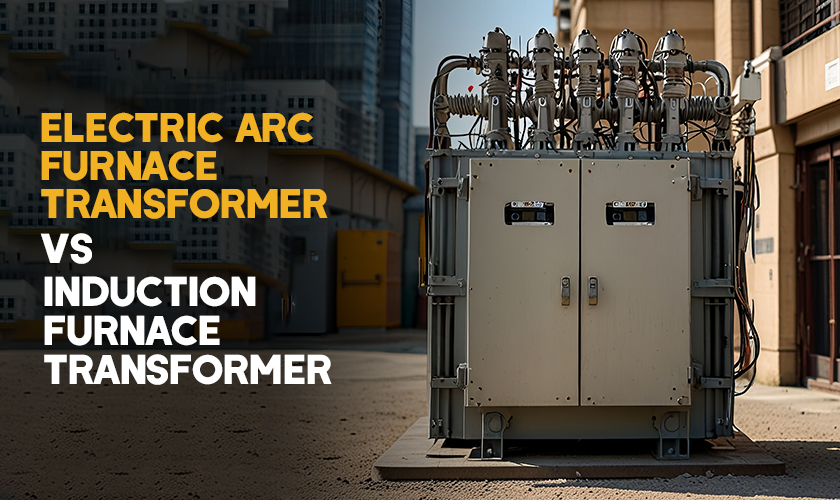
The Electric Arc Furnace Transformer and the Induction Furnace Transformer convert power into energy for melting metals. However, their characteristics are different in everything. Mixing these two types of transformers may be costly.
In this blog post, we compare these two types of transformers and explain why they are not interchangeable.
How an Electric Arc Furnace Transformer Works
The electric arc furnace produces intense heat through the formation of an arc between the graphite electrodes and the metal charge. The power supply to the electric arc furnace provides extremely high currents but very low voltages. The voltage in the secondary winding is between 100 volts and 1,200 volts.
The transformers used in the electric arc furnace work in a three-phase system with ratings above 22 MVA. The design of such transformers is made up of heavy-duty on-load tap changers, high-tensile strength windings made up of electrolytic grade copper, and forced oil cooling systems capable of handling 150% loads.
How an Induction Furnace Transformer Works
In contrast, an induction furnace relies on an altogether different system for heating metal. An electric coil composed of copper pipe produces a magnetic field with a frequency of 500 or 1,000 Hertz, which heats the metal charge internally. The step-down transformer reduces the voltage for this circuit inverter.
The loading curve of the machine is much less turbulent in nature. The absence of sparking and quenching does not cause any voltage surges within the system. Although the Induction Furnace Transformer carries high amounts of current, the strain is constant and thus allows for a less vigorous coil construction than arc furnaces.
Key Differences You Should Know
While both transformers serve furnace applications, the engineering behind each one reflects very different operating realities. Here's where the gap shows up most clearly.
Load Behaviour
An Electric Arc Furnace Transformer faces extreme load fluctuations. Current can spike to several times the rated value during arc initiation. An Induction Furnace Transformer deals with a steadier, more continuous load that's easier on the windings and core structure.
Voltage and Frequency
The core material used for arc furnace transformers runs at the standard frequency of 50 Hz but has low voltage and very high current. The core material for induction furnace transformers is designed to run at medium-frequency inverter systems.
Short Circuit Withstand
It is here that the gap begins to widen substantially. The electric arc furnace causes regular occurrences of short circuit situations whenever the electrodes touch the charge. The transformer should be able to withstand such continuous shocks without any winding distortion. According to the report by Metastat Insight, the global Electric Arc Furnace Transformer market will reach $508.87 million by 2025, registering a CAGR of 6.4%.
Source: Metastat Insight, EAF Transformer Market Report 2025 (Source)
Cooling Systems
Arc furnace transformers typically use OFWF cooling with heat exchangers, oil pumps, and flow meters. Induction furnace transformers usually rely on ONAN or moderately forced cooling, given their smoother thermal profile.
Choosing the Right Transformer for Your Plant
If your process includes electric arc furnaces for melting purposes and for recycling scrap metals, you will have to go for a specialised transformer built to withstand violent electrical surges. You should not cut corners where short circuit strength and cooling ability are concerned. In case you operate an induction furnace, there is no need for over-design since an induction furnace transformer is more efficient than the former.
According to a study by Future Market Insights published in 2025, the Electric Arc Furnace Transformer category accounts for approximately 29.4% of the total revenue generated by the speciality transformers market globally.
Source: Future Market Insights, Speciality Transformer Market 2025 (Source)
Conclusion
The question of whether one opts for an Electric Arc Furnace Transformer or an Induction Furnace Transformer is not based on which option is pricier or has better specifications. The selection should be based on compatibility with the furnace, the loading pattern, and production goals. Choosing incorrectly will create constant challenges.
Knowledge of the technical aspects of the options, such as load characteristics and cooling, will enable you to make more informed decisions when designing your power infrastructure.
Makpowerts produces both Electric Arc Furnace Transformers and Induction Melting Furnace Transformers, customised according to their respective purposes. Whether looking to install furnaces or upgrade transformers, their professionals will assist in determining your needs.Related Posts

A Guide to Effective Power Transformer Maintenance & Its Importance
Power Transformers are versatile and high-quality solutions for various.....

5 Things You Must Know Before Buying a Power Transformer
Power transformers are critical in the provision of constant electricity.....

What Is The Difference Between A Power Transformer And A Furnace Transformer?
Transformers are like the catalysts in the world of electrical.....

Guide to Installing, Commissioning, and Accepting Power Transformers
Power transformers are critical components in any electrical.....