

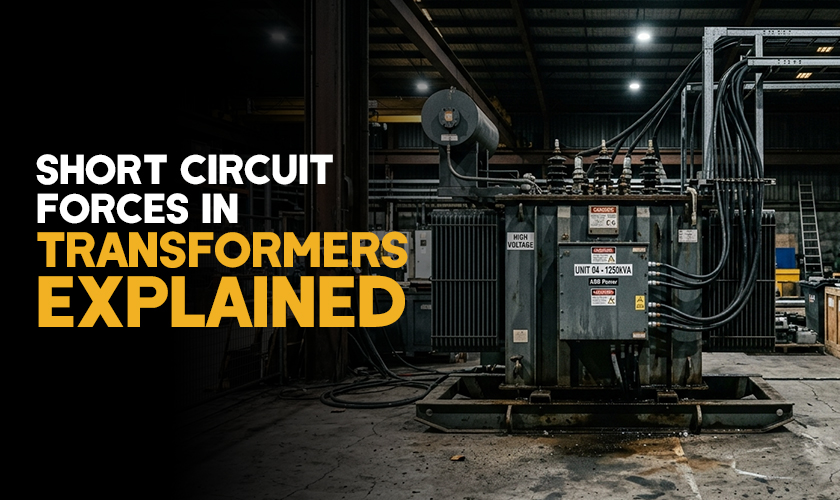
A transformer short circuit lasts for milliseconds, but the extent of the damage it causes takes months to repair, assuming the transformer itself is even able to withstand the impact. Among plant managers and electrical engineers, there are few problems more feared than a transformer short circuit because the power unleashed in those milliseconds is quite literally violent.
Not only does fault current cause an increase in current flow, but it also creates electromagnetic forces powerful enough to bend conductor wires, destroy insulation, and move coil groups within the core assembly. Unfortunately, many transformers that have endured one short circuit experience internal damage that makes them susceptible to future events.
In this blog, we will explore how a transformer short circuit occurs, why it is damaging, and how you can avoid it.
The Physics Behind Transformer Short Circuit Forces
In a short-circuit situation, the fault current flowing in the coils may range from 8 times to 25 times the rated current based on the impedance of the transformer and the level of faults in the system. The interaction between these fault currents and the magnetic flux leakage field within the transformer generates large electromagnetic forces in the conductors.
These forces depend on the square of the current value, meaning that doubling the current results in four times the force. This maximum force occurs at the peak asymmetrical fault current, which is experienced during the first half cycle after a fault event has occurred. The forces experienced by the conductor are on the order of kilonewtons.
Radial and Axial Forces: Two Threats in One Event
The forces acting during a short circuit are divided into two separate categories that work at the same time. The radial forces move the outer windings outwards while pushing the inner windings inward onto the core, effectively separating the two windings from each other. The axial forces act parallel to the height of the winding, trying to either squash the winding stack down or pull it apart.
As long as the windings are not balanced about axial forces and they never will be completely, the effect of unbalanced forces would be tilting conductors, shifting spacers and crushing the end supports. The inner winding gets squeezed while the outer one tries to extend itself. Both these forces act at once during each short circuit of the transformer.
Why Cumulative Damage Is the Real Danger
This is how many people misunderstand transformer short circuit occurrences. A transformer may make it through the first incident without any physical damage. However, every occurrence causes microscopic deformities in the winding assembly. The spacers move minutely. The insulation suffers permanent compression. There is a minor reduction in clamping pressure.
According to the INMR findings published in January 2026, the short-circuit withstand testing results for high-voltage power transformers conducted at a prominent laboratory over the past 20 years found that the rate of initial failures was around 23%. It wasn't made from substandard materials; it used the proper engineering practices. It is the result of multiple incidents that finally break down even the well-engineered transformers.
Source: INMR, Testing to Reduce Transformer Failure Risk, Jan 2026 (Source)
Signs Your Transformer Has Taken Short Circuit Damage
Transformer short-circuit failure does not always come to notice. It may not show up through visual inspection. However, some signs may help determine if something is wrong.
For instance, any deviation in impedance values by 1% to 2% means that the windings have moved out of place. Any strange noise or vibration while the transformer is in operation could mean that the clamping is loose or that the spacers have been moved around. High levels of acetylene or ethylene in dissolved gases could indicate localised overheating caused by deformed conductors.
How to Protect Against Short Circuit Forces
Protection begins with the design phase. The transformers designed for use in high-fault systems require a strengthened winding design, correctly sized spacing, and pressure clamping that takes into account insulation compression over time.
In operation, make sure that the protection relay isolates faults as quickly as possible. Every additional millisecond of fault time adds energy absorbed by the transformer. Testing of impedance values and comparison of FRA with normal values identify problems in their early stages, before they become a disaster.
Conclusion
Short circuit forces are one of the harshest stresses applied to a transformer. They are sudden, severe, and cause progressive wear and tear. Failure to acknowledge this fact is what leads to unexpected failures and unnecessary shutdowns in plants.
Through proper design and manufacture, as well as continuous monitoring, this problem can be significantly mitigated. Knowledge of the principles of operation of a short-circuit transformer is valuable information that will safeguard your investment.
The Makpowerts transformers are manufactured with strengthened windings, accurate clamping, and thorough in-house testing for short circuits. If your plant operates in an environment that exposes it to harsh fault conditions, their engineers can build you a transformer that can survive such conditions.
Related Posts

A Guide to Effective Power Transformer Maintenance & Its Importance
Power Transformers are versatile and high-quality solutions for various.....

5 Things You Must Know Before Buying a Power Transformer
Power transformers are critical in the provision of constant electricity.....

What Is The Difference Between A Power Transformer And A Furnace Transformer?
Transformers are like the catalysts in the world of electrical.....

Guide to Installing, Commissioning, and Accepting Power Transformers
Power transformers are critical components in any electrical.....